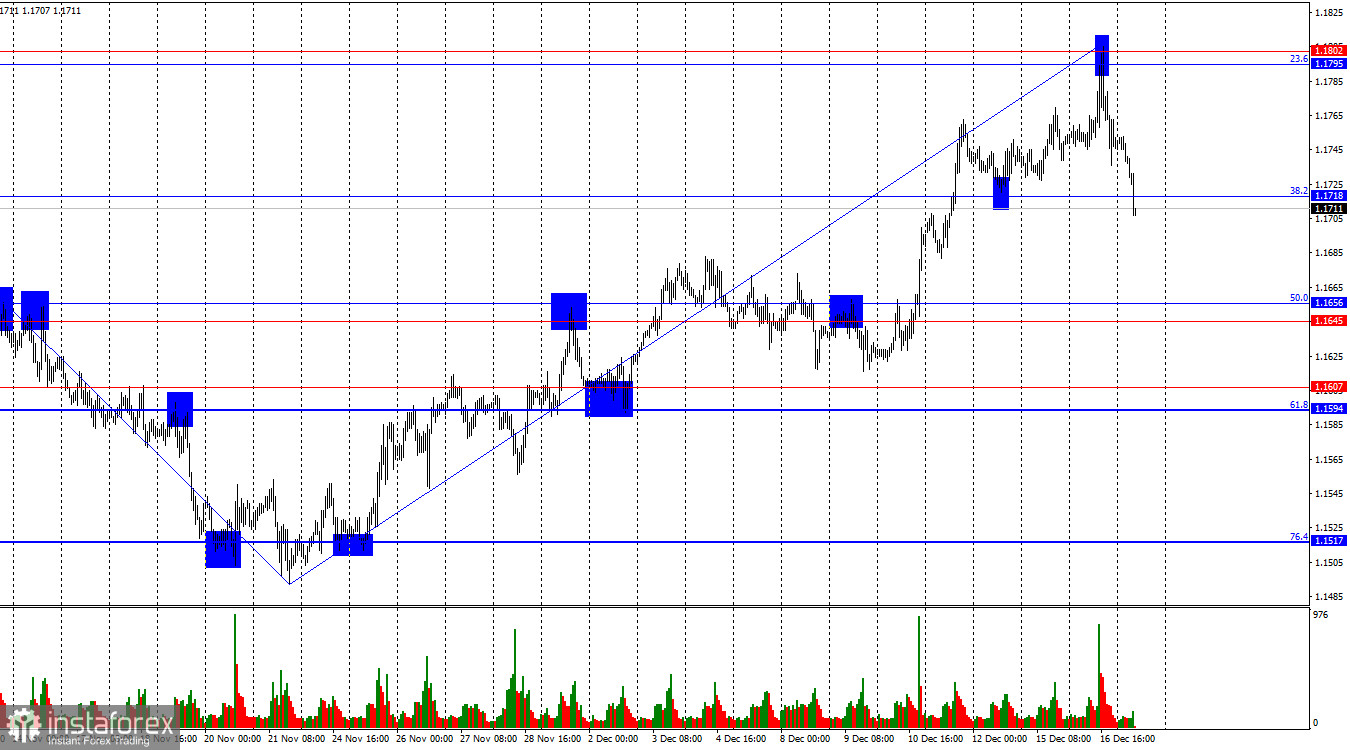
On Tuesday, the EUR/USD pair continued its upward movement after rebounding from the 38.2% corrective level at 1.1718 and by the end of the day reached the resistance zone of 1.1795–1.1802. A rebound from this zone worked in favor of the U.S. dollar and marked the start of a decline. This morning, the pair consolidated below the 1.1718 level. Thus, the decline may continue toward the next Fibonacci level of 50.0% at 1.1656. A renewed close above 1.1718 would once again favor the euro and a resumption of growth toward the 1.1802 level.
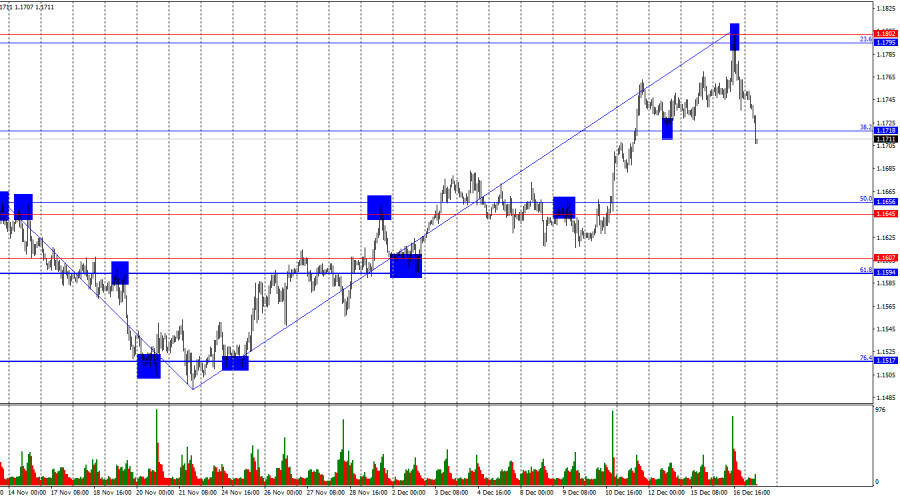
The wave situation on the hourly chart remains simple and clear. The most recently completed downward wave did not break the low of the previous wave, while the most recent upward wave broke the previous peak. Thus, the trend officially remains bullish. It would be hard to call it strong, but in recent weeks the bulls have regained confidence and begun to attack with renewed strength. Easing of the Fed's monetary policy supports further growth of the European currency, and the ECB will not create any problems for the euro in the near future.
On Tuesday, the news background was heavy for both the euro and the dollar, but I will focus only on the reports that the market actually reacted to. There were only two—Nonfarm Payrolls and the unemployment rate—and they turned out to be a tricky test. The unemployment rate rose unequivocally to 4.6%, but the situation with payrolls was less straightforward. The November report showed a higher figure than traders had expected, though not by much. At the same time, the October report "pleased" the market with a figure of –105 thousand, while September was revised up to +108 thousand. In my view, the Nonfarm Payrolls report could have been significantly worse, but the unemployment rate would have pushed the bulls into attack regardless of payrolls. The decline in the pair overnight and this morning I attribute primarily to the UK inflation report, and secondarily to a corrective pullback. There have been no corrective waves for quite some time, so one will not hurt the bullish trend.
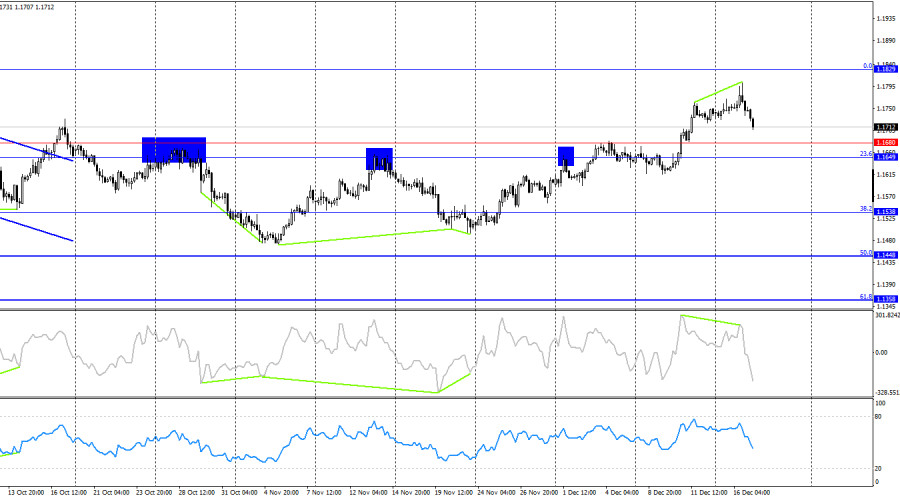
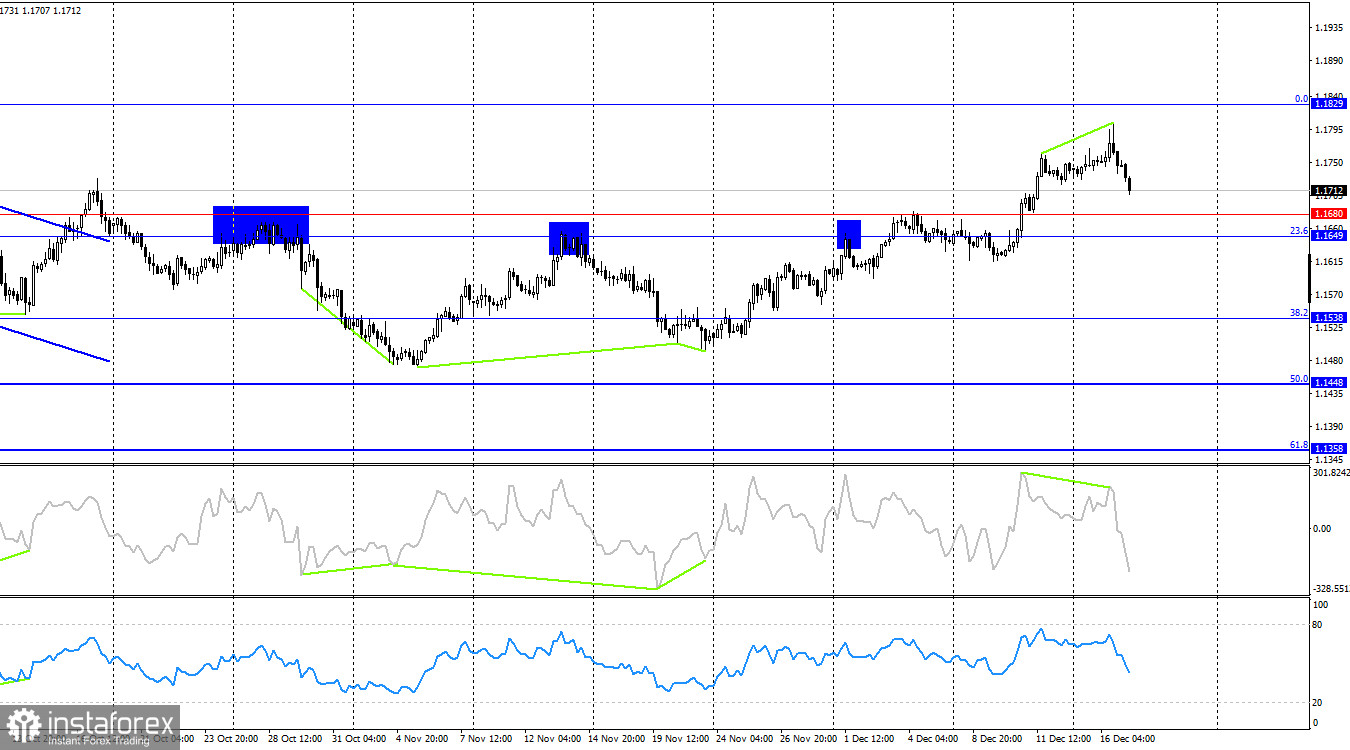
On the 4-hour chart, the pair reversed in favor of the U.S. dollar after a bullish divergence formed on the CCI indicator. Thus, the decline process may continue for some time toward the support level of 1.1649–1.1680. A rebound from this zone would favor the euro and a resumption of growth toward the 0.0% corrective level at 1.1829.
Commitments of Traders (COT) Report
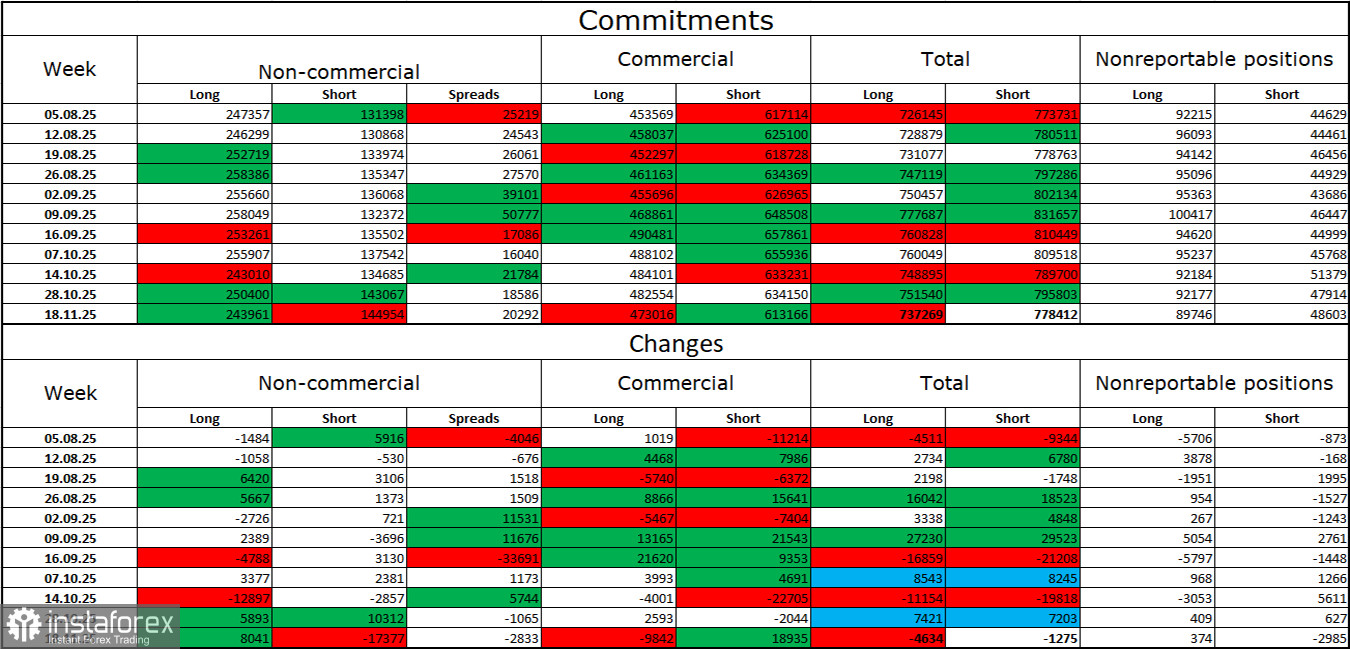
During the latest reporting week, professional players opened 8,041 long positions and closed 17,377 short positions. COT reports resumed publication after the government shutdown, but for now the data being released are already outdated—for October and November. Sentiment among the "non-commercial" group remains bullish thanks to Donald Trump and continues to strengthen over time. The total number of long positions held by speculators now stands at 243,000, while short positions total 145,000.
For thirty-three consecutive weeks, large players have been reducing short positions and increasing longs. Donald Trump's policies remain the most significant factor for traders, as they may cause numerous problems that would have long-term and structural consequences for the U.S. Despite the signing of several important trade agreements, analysts fear a recession in the U.S. economy, as well as a loss of Federal Reserve independence under pressure from Trump and in light of Jerome Powell's expected resignation in May next year.
News Calendar for the U.S. and the Eurozone
- Eurozone – German Business Climate Index (09:00 UTC).
- Eurozone – Consumer Price Index (10:00 UTC).
On December 17, the economic calendar contains only two entries, neither of which can be considered important. The impact of the news background on market sentiment on Wednesday will be very weak or nonexistent.
EUR/USD Forecast and Trading Advice
Sell positions could be opened yesterday after a rebound from the 1.1795–1.1802 level on the hourly chart, targeting 1.1718. The target has been reached. A consolidation below 1.1718 would allow traders to keep sell positions open with a target of 1.1656. Buy positions could be opened after a rebound from 1.1718 with a target of 1.1795–1.1802; this target has also been reached. New buy positions may be considered after a close above 1.1718 or after a rebound from 1.1656.
Fibonacci grids are drawn from 1.1392–1.1919 on the hourly chart and from 1.1066–1.1829 on the 4-hour chart.